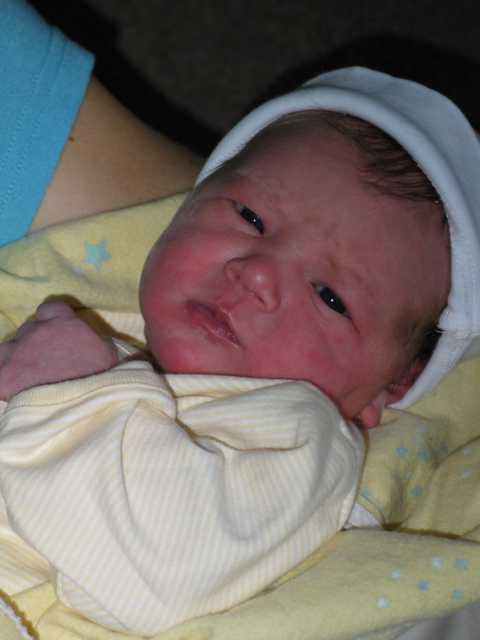
Tuesday, January 24, 2006

Grandmother’s advice: “"A cup of tea and a bran muffin, and off you go.”

Thoughts on birth... by Andrea
Don’t we overplay most major events in life? Don’t we overuse words like “excellent”, “amazing” and “excruciating”? Use “never” and “always” out of context?

So why, for certain major life events, like marriage, birth and death, does it seem that we underplay them? Marriage, modeled after some Disney version, is for another blog, on another day. So, for now, is death.

But birth is current for me, and Rosie’s arrival has me wondering why, apart from humorous musings of people like Carol Burnett (to paraphrase: ‘It’s like this: take your upper lip, pull it out as far as it will go, now lift it up and pull it over the back of your head.”), no one says anything, really, about it. Other moms smile a secret, knowing smile, now that you are part of the club. The nurses at the pre-natal classes show drawings, with the mom’s face getting progressively… well, squiggly. I have never felt “squiggly”, so this didn’t mean much to me. The baby books say things like “How you might be feeling: anxious, in pain, worried about the baby.”

But no one said:

You will go inside, deeper than ever before, and a fog will descend on the outside world.

Time, as you now think of it, will change. Contractions will last for eternity, yet the hours will go by like minutes.

At times, you will not just be in your body: you will be your body.

The word “excruciating” will, at last, mean something to you.

You will have to reach for strength in places where you have never looked for it. There is no way to practice this.

And no one said:

If you are lucky, there will be a moment where heaven opens up and pours its light down on your child. You might even hear a moment of angel music.

Memories of a birth...
From the first birth, by caesarian section, I only knew a bit about the contraction part. Before I went under the epidural that time, I got up to move and had one brief and, to me, terrifying glimpse of immense pressure. Wow, I remember thinking. If that’s what’s in store, I’m just as well to go for the anaesthetic.

And yet, after, as I reveled in my healthy boy, I had regrets. There was such a slim chance we’d get pregnant in the first place, and now I had missed the opportunity for this supposedly life-changing event of a “proper” birth. Had I wimped out too soon? Had I done something wrong?

I was able to push these thoughts away and delight in my blessings. But when the miracle of pregnancy happened a second time, I felt that this – a non-anaesthetized delivery - would be part of the lesson. My life often seems to me to be a series of lessons missed, lessons repeated, and I felt this would be one. Or rather, I really, really wanted it to be one, and so it was.

So I dug through files and friends to find you again, Jacquie. My rational mind (what an Anishnabe friend would call “monkey mind”) said things like: You won’t need a doula this time. You’ve basically been through this before. You and Mike and some nurses can handle it. It will probably be another C-section anyway.

My instinct, which I am continually trying to listen to with more open ears, said, call Jacquie. So I did.

Several months later, as I entered the chute into labour about a week early, I found myself panicking, despite weeks of pre-natal yoga meditations and some conscious effort to prepare myself for the event this time around. Last time, I had avoided thinking about my fears, and the pain. This time, I try to welcome those thoughts, especially when Jacquie asks me, is there anything on your mind this time? Pain, I hear myself say. Yeah, she replies, it’s there. You just have to go through it.

But as the early contractions drew me into the cave, I had an initial fleeting panic. I’m not ready yet. I had other plans this week. This baby can’t really be coming now. And then the panic was replaced by the simple thought that, at any point, we could call Jacquie. So we did, and it was off to the hospital.

At first, I was as I say “in the cave”. You can stand up and move around in the cave, you can talk to other people. As dilation progressed – way, way too slowly for my liking – I was still able to respond to her suggestions. Gently rubbing my back; let’s shake those hips, dance that baby down; why not try the shower? In the moment, all movement seemed ridiculous to contemplate, and yet once encouraged, there was always new relief.

And there was her anticipation and reassurance. In the cave, you don’t try to stop your body, or, as my g.p.friends put it, ‘smooth muscle has the power of veto’. With every new turn, Jacquie is there. You’re safe. You’ll feel pain here, and here – it’s safe to feel that pain, go with that pain. (I had a yoga teacher once who tried to get us to meditate through itches, to get us not to lift a finger to scratch at a nose or cheek. “Go into the itch instead”, he would say. “Become the itch”.) So it is with the pain, except that I have no power to do anything but go into it, to become it, or to try to resist it, which doesn’t work. Let go, says Jacquie. Unclench your hands and see what happens. Not believing but trusting anyway, I let go my hands, which have been clinging to Mike’s, and feel myself drop. I’m dropping out of the cave. It’s time to push.

In the state of pushing, I am in a tunnel. I’m not just watching – I’m there. It’s brown in there, and as I push further and further I go through large, flat bubble-like things which are light brown. They are the pain. The tunnel, I now believe, is the birth canal.

The first time I push, I do so naively. The pain is quite something, and I’m just wondering how I’m going to manage it (assuming I’m not one of those moms who later says, almost blithely, well, it was intense, but he was out in 2 pushes), when I hear Jacquie again. She’s farther away now – no one can come into the tunnel with me, there isn’t room for one thing – but I hear her say: push through the pain; there is another side at the end – a place you can push off from. Some people say that it actually feels good there.

Again, I don’t really believe it, but since I’m going to have to push anyway, I go as far as I can. Descent, pain, pain, and – there it is! A push-off place! Now, the descent into the push is like wading through a gooey swamp, and at the end is dry land, terra firma, where I can gather my strength and really step off, back up towards the light, the room, breath, and water. It doesn’t exactly make me look forward to the pushes, but it gives me something to reach for, that will provide some relief and also sense that I am doing something, that we are going somewhere.

I wonder if I can put into words the incredible bonding I now feel to this woman, who can issue directions I don’t believe and have me follow them anyway, only to discover they are true. No, I don’t think I can put it into words.

I am pushing in series of 3-4 pushes per contraction. The tunnel looks the same each time, it feels the same each time and this is odd to me in the moment: why am I not feeling – or “seeing” - forwards progression? Why, indeed, is this kidlet seeming to move, and then slip back? I am tired and tiring faster still, I want to quit, I am not proud, I can’t do this, I feel free to tell anyone who will listen. And, there is Jacquie again, bringing Mike in with her – they are my pit stop crew as I come around the circuit and wait for the next contraction; they whiz around me getting water, moving blankets, getting cool cloths, and always, always, cheering me on, with an energy that only later strikes me as incredible, given that they do not have the adrenaline of labour, and have not had any sleep.

But even the pit stop crew can’t give me muscle power I don’t have. My legs and arms are starting to shake. I find myself mentally ready to push harder but physically, I am just giving out. Even my uterus must be getting tired – the contractions are coming less frequently now (how can that be? I wonder fleetingly) and seem less intense. And my will to descend again and again into the tunnel is waning. Unbidden, I am hearing the voices of women saying “just two pushes.. two pushes… two pushes”. I am starting to feel resentful – where are my two pushes? I’m working hard here! Where the heck is this baby? At one point I reach down to touch the head – I saw this in a pre-natal video, and always thought it must surely be one of the most inspiring things a mother-to-be can do. But as I touch it, all I can think is – great: now where’s the rest of her?

I am spent, but no one seems to be rushing to get me out of this. And now, without knowing where the energy comes from, I try to drown out the womens’ voices. I reach, and what I come up with is what the pre-natal yoga instructor said, as she had us pump our arms to banish our fears. We would pump, in and out, out and in, eyes closed, well past the muscle-burning point, and as we huffed and puffed and squinched our faces up, she would say, calmly, Keep going. You can do this. You will need all your strength and more. You can do this.

So I say, weakly, barely whispering: I can do this.

I can’t imagine anyone will hear me, but Jacquie does, she picks up the line and throws me an end and then pulls, hard: that’s right Andrea. You can do this. You can do this. I allow myself to be pulled along, and we go through some more contractions.

And at last, it is time for the baby to be born. The doctor will help, there will be an episiotomy: OK Andrea, one more push, and you’ve got a baby. Suddenly, the tunnel widens, I can sit up in it, and there is a doorway coming closer and closer. At the last minute, Jacquie calls into the tunnel “Andrea! Open your eyes NOW!

And I do, and there is the light of heaven and the moment of angel music, and my daughter, and my tears and laughter and joy all filling the room, as she, and I, emerge into the daylight, into the world.

Thursday, January 05, 2006

Birth is a challenge of the mind, not the body


Think of all the challenges that you have faced in your life - physical, emotional, and intellectual. You have been preparing for this for all your life. You will need to draw on all your life lessons to make it through labour. You don’t need to have experienced extraordinary pain - this isn’t like breaking a leg, or undergoing surgery. All you need is to have lived, faced difficult times, and struggled through to the other side.

Have you ever walked out of your house, and been amazed that everyone is walking about, laughing, doing their shopping, unaware of the challenges that you are facing? You have been facing such a trial that you have stepped out of space and time for a while. You ask yourself, “When will things go back to normal?” This happens in labour.

Have you faced adversity with your partner, greater than anything that you could ever have imagined, only to find that it has forced you to live more deeply and fully together, to love each other without masks or pretense? This happens in labour.

Have you ever lost a loved one, only to discover that you now see the world with greater clarity? You are surprised that there is intense joy even in the face of such pain. This happens in labour.

Have you ever had to take a leap of faith - into love, or a career challenge, into an exam, or even sky-diving? You are open, vulnerable, naked. You have given up control. Yet, how often do you find that you were a prisoner of your own fears, and that the reality of the leap is freeing? In relinquishing control you gain control. This happens in labour.

Are you surprised when you are in the middle of an emotionally painful event, realizing that you are going through what you most feared, and you are making it through, one moment at a time? This happens in labour.

Birth may be sacred, but it is something you will recognize. With support, you will discover so many things which are similar to your past challenges. You have been prepared for this.

"The baby tumbled/head over heels over head/down, down to Earth"


Jaya - one day old

Strength is not in her/but she enacts it as the wind fills a sail


Each and every birth I attend is a profound and unique gift. But sometimes, just sometimes, events conspire to make the day even more inspiring. Tuesday was exhausting, cathartic, and joyful for all of us. I can’t even put it into words. Even talking with my client just now, rare tears flowed when I shared some information about how the obstetrician had helped her. The obstetrician, with her private source of inspiration drawn from losses of her own, trusted my client’s need to do this her own way, and in her own time. The obstetrician agreed that if my client had been given an epidural, a repeat cesarean would surely have followed. We had all reached deeper than usual to support this woman fully through her life-changing day.

So here’s the basics on paper:
Previous cesarean for 10 lb baby
Arrived at hospital 6-7cm after 4 hours labour
Movement, shower, swaying, rocking, gas
Fully dilated after 7 hours at the hospital
No epidural, no forceps, no cesarean (to the staff's surprise!)
Just plain hard work, squatting, moving
Born after 3 hours pushing - an 8lb 5 oz girl!
"You have the most beautiful ears!" says the pediatrician to the baby

My experience was of a continuous flow between us, connecting us like a rope, a lifeline. Her husband would whisper encouraging words softly. With every single contraction I would say, “Breathe in strength...you can do this...breathe out...you are safe...deep breath in...blow it away...breathe in for baby...blow it away...deep breath in...you are safe...you can do this...” On and on, hour after hour, one contraction at a time. Resting in between: “Feel how amazing the rest is, your head is heavy, your face is smooth, your arms are heavy, your legs are heavy, your bottom is loose.” Hips shaking, pelvic rocking, foot massages, constantly moving... If I stopped talking, she would call, “Jacquie!” or “Talk!” I would hear her mouthing the words, “I can do this!”

The mum says she is changed by this experience. Here are some quotes from our talk this morning:
“I will be a different person after this”
“I was reaching to new levels of my own strength”
“One step at a time...like a rock climber...I was putting hooks into things...”
“When I was pushing, you said to push through the pain and I’d come out the other side - it worked!”
“You knew exactly what I wanted even before I knew what I wanted”
“With each contraction, it was like I’d jump over a crocodile laden swamp and would land safely on firm ground on the other side”
“How are you able to translate birth into all venues and all languages?”
“It’s like you are my fairy grandmother”

Many thanks, Andrea, for your inspiration. As your daughter’s birth has changed you, it has also changed those of us who helped you. Thank you for allowing us to bear witness to your strength.

Wednesday, January 04, 2006

The Meaning of Pomegranates and Northern Lights


Birth imagery is everywhere, from the paradox of the pomegranate in ancient writings to the joyful and whimsical life-giving nature of the Northern Lights found in Native storytelling. Whenever I have been challenged by a birth, or face great joy or loss in our own family, I go to my books. Research is my way of coping with challenges. I haunt creaky-floored second hand bookstores, sit on the floor of the library, or google my way to new understanding.

This month, I started with Tomson Highway's prose, both profound and profane. His imagery of the spirit child who is formed in the Northern Lights and tumbles to earth is magical. There is a bubbling life-force in his words. Then I moved on to reading tales of Persephone and the pomegranate; stories of the potency of life. Seven stars on the tiara created a fetus. Seven seeds of a pomegranate forced the eternal union between Persephone and Hades, creating both life and death in the seasons. I seek connection in these writings...

"As its galaxies of stars and suns and moons and planets hummed their way across the sky and back, the Fur Queen smiled enigmaticaly, and from the seven stars on her tiara burst a human foetus, fully formed, opalescent, ghostly."
- Kiss of the Fur Queen by Tomson Highway

"A single fruit grew on that tree, a bright pomegranate fruit. Persephone stood up in the chariot and plucked the fruit from the tree. Then did Aidoneus prevail upon her to divide the fruit, and, having divided it, Persephone ate seven of the pomegranate seeds."
- The Golden Fleece by Padraic Colum

When I found myself attending my 600th birth on the same day that there was a loss in our family, I drew strength from the words that I had read. To help my client birth her baby who was posterior, a star-gazing child, I gave her images of tumbling and turning, slipping then sliding (thanks to Tomson Highway). Her baby finally tumbled from her body. The next day I bought a pewter pomegranate as a gift, to honour the lives both lost and found.

When I look at the birth books on store shelves, I am saddened by their lack of depth. But when I broaden my search to include ancient texts, modern literature, history books, poetry, and the oral traditions of other cultures, I am inspired. I hope that, in turn, my explorations help others to find meaning.

In memory of the spirit baby...

Tuesday, December 13, 2005

"To sleep/Perchance to dream"


I love the drive from a client’s house to the hospital. I’m following my clients, watching the labouring woman’s hand reach up to the roof of the car during each contraction. For me, it’s an in-between time of quiet watchfulness, similar to that “out of time” feeling I remember while feeding a baby in the middle of the night.

Last night, we had a long drive from Surrey to Burnaby General. So, I turned on the radio to CBC Ideas and heard an amazing piece by Jeff Warren called "While You Were Out" about the changes in sleep patterns over the last three hundred years.

References to “first sleep” are present in Renaissance and pre-industrial writings. Only now are researchers discovering that our biological sleep pattern has two main cycles, “first sleep” and “second sleep,” with a two hour intermediary trance-like period, “the watch.”

After sunset, the family would head to the communal sleep space. There would be a quiet period of 1-2 hours rest in the dark, followed by “first sleep,” a deep rejuvenating state. This long wave sleep state would increase the levels of prolactin (ah, the breastfeeding hormone!) After 4-5 hours, people would enter an altered state of consciousness, induced by these high prolactin levels. Any breastfeeding mum knows the timeless trancelike effect produced by high prolactin levels - patient, waiting. In this period, people would traditionally pray, muse on the day’s events, or quietly make love, while listening to the natural sounds around them. Later, “second sleep” would come, full of REM sleep and dreams. They would all wake at sunrise.

This sounds so much like a typical night with a new baby. Hmmm... Rather than seeing the postpartum sleep pattern as unnatural, perhaps we should see this as our return to our natural biological state. Sleeping alone in a room devoid of sensory input seems to be an unnatural state for humans. Our North American need to mold our babies into beings who can sleep alone for long uninterrupted periods is, in fact, altering the delicate hormonal and chemical balance in our bodies.

So, have a quick read of the article, “The Cultural Biology of Sleep,” before delving into Carol Worthman’s research papers, which include “The Ecology of Human Sleep.” You may find some food for thought during “the watch.”

Friday, December 09, 2005

778-883-9851...vancouverdoula@gmail.com


All my previous clients have the correct spelling of my name "Jacquie Munro" and my email address. But doctors who've run out of my brochures resort to scribbling down my name for their clients... Oh, dear, just look what happens then...

Yes, I think it's time to send out more brochures when:
1) Clients try to google my name but have been given the wrong spelling,
2) A client sees an article about me, phones up the newspaper, then has to convince the editor to release my phone number (very resourceful, but could have resulted in the end of the search),
3) Old-school clients look for me in a phone book (no, it's not there!), and poor Jack Munro or Jackie Munroe, etc., still get the odd message about "wanting a doula" on their voicemail, or
4) One potential client googles "Adoula" thinking it's my name...nope...my name is not Adoula Munro.

People can always find me by googling "Vancouver" and "doula", since I'm "Vancouver Doula". Plus my email address is vancouverdoula@gmail.com.

But I still think I'll head down to the printers for some more moo cards...so the midwives and docs can still hand out my cards with the pretty photos...

- Jacquie Munro, Vancouver Doula

Wednesday, December 07, 2005

“Come out of the circle of time/And into the circle of love” - Rumi


In the past, it was the partner’s job, as coach, to time each contraction with a stopwatch. I still have my old list of “...8:27...8:39...8:45...8:54...”from my first labour in 1983. The fixation on time has continued. Now there’s even a program that you can download to your Blackberry which will graph your contractions!

In contrast, I encourage my clients to let go of actively timing contractions at the beginning of the labour process. I think timing contractions is almost too simplistic a gauge of how labour is progressing. It makes you focus on an external reality and lose touch with your inner rhythm, your inner knowledge. It can also make you fixate on how long things have been continuing which, in turn, can lead to frustration or impatience.

Take me for example. There I was, waiting for my first labour to start. I was 10 days overdue. On paper, it looked like I had been in labour for a week. Contractions were every three minutes - sixty seconds long. I thought I was going through the longest labour on record. But I was still able to walk and talk through each “contraction.” I was really just having prelabour tightenings. But my fixation on timing had made me exhausted and mentally drained even before the true labour began. If I’d been able to talk with someone a few times a day during that last week, someone who understood the logic of the body and the rhythm of labour, I might have been able to rest more, and been more emotionally capable during the true labour.

Now, when I’m working as a doula, I try to help people deny the niggly prelabour stuff. If you think of the early symptoms like the start of a period then you may be able dismiss the first signs of labour (the “forget it” stage). Sure, we talk on the phone during this period, but you certainly don’t need to time anything. If you only attend to the active part of labour, where you can no longer deny it, it will feel like your labour is shorter. (Like a client this year who denied things so beautifully throughout the day that she asked me, "Do you really think I'm in labour?" when I arrived at her house. It was only 5 hours later that her first baby was born.)

Now, I watch the momentum of labour, the woman’s movement, her face. Is she flushed? Are her knees bent? Is she rising onto her tiptoes at the peak of a contraction? How much clothing can she stand to wear? What sounds is she making? All these things tell me how her labour is progressing. But I’m not the “keeper of the wisdom.” In prenatal visits, I share all these secrets with clients.

I just love it when I get a phone call from a dad..."Uh, she’s doing that thing you showed us on the chair. The contractions only started half an hour ago, but I think we should just meet you at the hospital." I can hear her low moans in the background. It’s so great to know that he “gets it,” and hasn’t had to rely on timing contractions to determine the fast progress of her labour.

If you truly MUST write down the contractions (for the baby book), do it. It can be a fun way to keep busy during early labour. But it’s only good at showing you exactly when active labour starts. When does that happen? Well, the moment a woman says, “Put that pen down and rub my back!” she has reached the start of active labour. Oh, and another great indicator of the beginning of active labour is to play a game of cards. I was at the hospital with a woman who was being induced. “When will I know that it’s REAL?” she asked. “Well, when you throw your cards at me,” I said. It was only another half hour later that she threw the cards down. “Now, I know what you mean,” she laughed, as she jumped out of the bed. Ahaa! She had entered active labour.

So, here’s a great way to access your instinctive side: Take off your watch, turn all the clocks around... and feel the rhythm of contractions. For example, you can lean on the kitchen counter for a contraction, then pick a walking circuit around the house. You might have to walk three circuits before another contraction comes. After an hour, you may only be able to complete two circuits before the contraction comes again. You will know “in your body” the rhythm of labour, and won’t need to focus on time any more. Once you are able to flow with the labour, this will encourage a trancelike state (ah, endorphin release!), and help you go deeper into labour. But, always remember to keep in touch with me and your midwife or doctor. Oh, and we’ll know that it’s time to go to the hospital when you can’t walk another circuit (I will certainly be with you by that time!)

Every labour is totally different. Some women follow the textbook and have contractions which increase in length, strength and frequency. Other women can have contractions which are fast and furious from the first contraction. On rare occasions, some women find that their contractions are “pokey” all the way through. Labour is not a linear process; it ebbs and flows as the body and your baby requires. I will help you navigate this rhythm. When I talk to you on the phone, I will be thinking about how many times you have to stop talking (i.e. have a contraction) within a 10-minute period. In early labour there might only be one contraction every 10 minutes. Generally, in active labour, 3-4 contractions will occur in each 10 minute period. But the sooner you can let go of time, let go of your “thinking brain,” the sooner you will experience the timeless rhythm of labour. You will be able to cope much better.

So, I encourage you to trust your body’s rhythm, drawing guidance from your chosen caregivers. Talk to your doctor or midwife in advance about phone contact in early labour. Remember, you’ll be talking with me on the phone A LOT in early labour, and I will come whenever you need me. My arrival isn’t based on time, but on your need for extra support. Or your partner’s need for support! Then...I’ll be there.

Friday, December 02, 2005

Helping mothers open the door to life


Journalism students at Langara College produced eight weekly issues of The Voice newspaper. As a final test of endurance the pressure was ramped up and in the ninth week they produced four daily newspapers. Adam Johnson's submission made the top story in "The Best of the Dailies!"


“A 65-year-old midwife held my foot and she didn't move. Then she would look up and she'd smile. And I thought, obviously things are okay.”

“I just said, I need to do this.”

The deep kindness in her eyes grows determined as Jacquie Munro, 45, describes the day she found her calling. She was inspired by her second birth to share this positive experience with others. That was 18 years ago.

“It altered who I was radically,” she says. “I wanted to change people's lives the way they had changed mine.”

She began working as a childbirth educator, but when her students kept having difficult births, she decided to guide the next batch through the process first-hand. Eventually, it became a fulltime job. While she initially called herself labour support, the word Doula came into use in the early 1990s.

Doula is a traditional Greek word referring to an experienced woman who helps other women through childbirth. In its modern connotation, it is someone who counsels the mother before, during, and after childbirth, without actually birthing, or “catching” the child.

It is a job of simple acts, small gestures, and one hell of a lot of work. “It's often just eyes and hands—and just one word,” she says. “I just say, you are safe.”

On her kitchen table, Munro looks over a huge stack of file folders, each representing one of the 602 lives she has helped into the world. “God, I've been doing this a long time,” she says, smiling at the size of the stack.

She says the most important thing she does is provide continuity of care, by being there for the mother during the entire birthing process.

She says this continuity is sorely lacking in the current health care system, where mothers often deal with overworked health care workers.

Munro acts as an intermediary between the mother and the health care system, arranging the trip to the hospital, consulting with doctors and nurses, and maintaining a safe atmosphere for the mother.

“In births where there isn't anyone looking over the mother, a woman's autonomy can be lost completely,” she says. “You become a patient, which is usually very submissive.”

Munro seeks to create an atmosphere and mindset where a mother can get into the “birth trance,” a state of surrender and acceptance that allows the childbirth to proceed naturally. “It's completely analogous to lovemaking,” she says.“You cannot surrender to the process unless you are safe.”

But Munro insists the labour stage is the least of her concerns, pointing to staffing shortages at hospitals and the limited availability of rooms and medication. She is also concerned with the recent trend towards cesarean sections in place of natural childbirth because of the serious health risks associated with this procedure.

However, when necessary she uses all the tools of modern-day childbirth. “Labour pushes you to the very edge of what you think you can do, but it shouldn't be torture.”

After hundreds of births, Munro still finds profound meaning in the experience.

“When I'm in there with people in birth, it's like the door between life and death is wide open,” she says.

Munro presents a happy and vibrant personality, and demonstrates the limitless patience of someone who spends days massaging backs and easing nerves.

But there is a deep, underlying fatigue associated with work that requires such an emotional commitment.

“Last week I did three births in two days. I had four hours sleep in 64 hours,” she says, smiling. “But it's great.”

by Adam Johnson
Langara Journalism Student (Certificate Program)

Wednesday, November 30, 2005

On Memories


"So much of our early gladness vanishes utterly from our memory: we can never recall the joy with which we laid our heads on our mother's bosom or rode on our father's back in childhood; doubtless that joy is wrought up into our nature, as the sunlight of long-past mornings is wrought up in the soft mellowness of the apricot; but it is gone for ever from our imagination, and we can only believe in the joy of childhood."

George Eliot, Adam Bede

Conscientious parenting begins before our children are born. Writing a pregnancy and birth journal can help to create wonderful memories for our babies. My own children loved it when I read my journals aloud at bedtime.

Sarah would ask, “What did you do before I was born?” She was fascinated to hear about what daddy and I had done in those weeks of waiting in the August heat. She loved hearing that she had tried to forge her own path out of my body. "You wanted to come out facing forward, so you wouldn't miss seeing a thing! But you finally spun around and came out with a splash!"

“Read the part about how I peed all over you!” my four-year-old son would laugh. Then I read to him, “The midwife told me to open my eyes and look down. Someone held my head and helped me to curl around my tummy as you tumbled out onto my leg. You were so heavy and slippery. Then you peed - so hot! - up my body. And we all laughed! And your daddy cried as he called out - It’s a boy! We couldn’t believe it. We were sure we were having another girl. Then we said your name - Alexander.”

These stories are like family rituals, forming a strong core onto which all the other family memories bond.

“You say you want a revolution/Well, you know/We all want to change the world"


“Crisp and non-preachy” is how John Lennon’s Revolution was described on the radio today. After almost 40 years the form of the message is still unmatched. What would John Lennon have said about the social and political climate in 2005?

I think I’m pretty clear on what he might have said about George Bush and Iraq. But what would he have thought about the “Britney Spears School” of birth? Would he have commented on the “Too Posh to Push” scene? Would he have questioned why women seem to be so scared of their bodies?

This evolution (devolution?) in birthing practices seems to be leading us towards the world portrayed in 1984 or The Giver. How do we call for a change, a revolution, in the birthing world, without sounding preachy? How do we stop the l
oss of “normal birth?”

These questions made me sit down today to check out my 2005 stats. I needed to look at them to see how many “normal births” I’d attended this year. I’m so pleased that, out of the 79% spontaneous vaginal births, 61.4% of my clients had simple no-fuss births, and only 3% had unexpected cesareans. So I think you can say I’m part of a revolution against the “Too Posh to Push” tide, one woman at a time. And don’t think that my clientele is skewed towards young “low-risk” women. The majority (56%) of my clients are over 36 (10% of which are over 40).

What I do isn’t about the stats AT ALL . My aim is to help each woman forge a memory that is positive and empowering. There is no judgement against the women who need cesareans or epidurals, forceps or inductions. Actually some of my clients who have very difficult, intervention-filled labours are the most empowered by their experience. But I try to keep things as simple as possible for everyone, to ensure the smoothest transition to parenthood. My greatest joy comes when I hear, “If I can get through labour, I can achieve anything!”

When I hear that, I know we can start a revolution...

70 births so far in 2005


Spontaneous Vaginal Birth 79% (55)
Assisted Birth 5% (4) (1 vacuum, 3 forceps)
Cesarean birth 16% (11)
13% Booked (7 breech, 2 sets twins) (What's with the 10% breeches?)
3% Emergency (1 fetal distress, 1 transverse arrest at 10cm, both w/previous epidurals)

Simply Straightforward Birth (i.e. No intervention, no meds, excluding nitrous oxide or TENS) 61.4% (43)

Epidurals for Vaginal Births 21.4% (15) Reasons: 4 to stop early involuntary pushing (1 resulted in vacuum), 1 hernia pain, 1 prophylactic for low platelets (w/no further complications), 3 for pain (2 resulted in forceps), 5 with oxytocin induction/augmentation, 1 for forceps (baby to SCN)

Place of Birth
Hospital Births
93% (65) BC Womens (51) (1 diverted from St Pauls), St Pauls (11), Lions Gate (2), Royal Columbian (1) (diverted from BCW)
Home Births
7% (5) (4 planned w/midwives, 1 unplanned w/paramedics!)

Caregivers
57% (40) Family Practictioners
34% (24) Obstetricians
9% (6) Midwife

Client Age
20-29 11%
30-34 33%
35-39 46%
40+ 10%

- Jacquie Munro, Vancouver Doula

Tuesday, November 29, 2005

“There’s snow! That means it’s winter, so the baby must be coming!”


...to paraphrase an excited older sibling (age 4) this morning...

So cool that her logic worked so well. Mummy and daddy have said for 9 months that the baby will come in the winter. It snows in the winter. Today it is snowing. Therefore, the baby must be coming today.

And the baby came. What a drive through snowy streets to the hospital! What joy to find that my client had already surpassed her last labour’s dilation! What a triumph for her to labour without intervention or medications (other than nitrous oxide gas - which doesn’t count, right?) and birth (with under an hour of pushing) a glorious 9lb 1oz baby girl!

This VBAC (vaginal birth after cesarean) was the talk of the hospital today. Congratulations!

- Jacquie Munro, Vancouver Doula

Monday, November 28, 2005

Mail sampler (to encourage new mums)


Dear Jacquie,

Sam is 10 months old now, and doing really, really well. She is a very mellow, happy baby (and she sleeps through the night which makes life SO MUCH EASIER).

My birth experience has stayed close to me through everything - to be expected, I suppose, but it has become a memory that I draw on when I'm having one of those tough days (i.e. not enough sleep, Sam teething, Sam not eating her peas, all of the above in combo with PMS - I *so* didn't miss my menstrual cycle...). My memories are overwhelmingly positive, and much of that has to do with your calm presence throughout. You set the tone, you guided me to that place where I knew that my body would - and could - do what needed to be done. That strength and confidence has made all the difference, particularly during the early months when everyone around me seemed to think they knew what Sam needed better than I did; whenever I've had doubts, I've gone back to that basic trust in my body, and it has so far given me the best advice.

My trust in my intuition, and in my body's ability to take care of itself and my babe, is at the very core of my mothering. I think that your guidance through the birth helped me find that - and for that I thank you. I hope you're available when we do this again! I'm really looking forward to it. How weird is that? I must be ovulating... ;-)

I hope all is well with you and yours!

Maureen

Sunday, November 27, 2005

“In and out like a fiddler’s elbow”


I laughed when I heard this expression on CBC radio this morning. It’s supposed to mean that you’re really busy. Well - that was me this week. It had started out quietly...

And then...

Three births in two days. But the crazy thing is that I didn’t get more than four hours sleep in 64 hours. People said I looked alert and I felt fine the entire time.

I know that if I’d been at only one birth I would have fallen apart. But attending three births, each with their own special atmosphere, flavour, challenge and fun, seems to be what made the difference.

Challenging and fun it was!

It all began with another day of diversion at BC Women’s Hospital. Funny word “diversion.” The dictionary definition is “an activity that diverts, amuses or stimulates.” Hah! Yes, it is certainly stimulating when the hospital is on diversion. In hospital-speak, diversion is when the hospital cannot accommodate a patient. That’s just fine when it’s a general hospital. You just wait. But labouring women can’t just wait. You get sent, or “diverted” to another hospital. On Wednesday, my client was sent to Royal Columbian Hospital. The next patient after her was sent to Ridge Meadows...the next to Victoria. It’s too upsetting to think about those other women.

Luckily, once my client arrived at RCH, she was given the top birthing room. She dubbed this “The Las Vegas Suite” because of the oversized bathtub smack in the middle of the room. Details aside, this was an amazing birth. She showed such strength and power, trusted me when I said “You are safe,” and pushed out a glorious 9lb 11oz baby boy.

When I returned home on Thursday at dinner time, I didn’t go straight to bed. I wanted to enjoy the evening. How silly of me... I was out again by 11pm, heading for a home birth. I was relaxed. I knew there would be no emotional struggle against the system, no worrying if there was room at the inn. We just had to honour the flow of labour.

Well, there was one moment of anxiety when my client worried that the baby might be born before her older child woke up. No need to worry, though - we had tucked her and the new babe into bed, cleaned up the house, and driven away before her daughter ran into the room. What a morning of discovery for the family!

Then, when I’d only been asleep for two hours...

The pager vibrated off my bedside table. A client needed an emergency induction. The self-described “pessimistic” obstetrician held out little hope for a vaginal birth. But, after only 9 hours of active labour, and “optimistic” heroics supplied by the family practice doctors, my client greeted her gift of a lifetime - a wide-eyed son. Not a small feat for a 43 year old single mum who had hardly dared to dream about this day.

I drove home at midnight. The nurses called out to me as I left the building, “Drive slowly!” “Be careful!” “Keep the windows down!” “Sing loudly!”

I thank them all for their care.

Dawn Streetlamps


there is something beautiful
about the sight of three midwives standing outside
at dawn
under the halo of streetlamps
sifting through the night's events

a neighbour leans out of a doorway
Have they had the baby yet?
Yes!
Is it a girl?
We can't tell you!

laughter as they drive away
the tires shushing on wet roads

- Jacquie Munro, Vancouver Doula

Tuesday, November 22, 2005

"Take no advice...follow your own instincts...use your own reason, to come to your own conclusions" - Virginia Woolf


This week is shaping up to be “postpartum visit week.” Lots of wee boys (and their tired mums) to visit. I’ve also heard from clients whose babies range in age from three to eight months. We’ve discussed everything from sleep deprivation to “what the poo should look like.”

The major issue this week isn’t (thankfully) breast-feeding. Pretty much everyone is doing well and producing abundant quantities of breast milk. One client is even donating her extra milk to the Children’s Hospital Milk Bank, (604) 875-2345, ext. 7607. Another just phoned to say that, with the help of Renee Hefti-Graham (604-733-6359), her little girl finally latched successfully at six weeks and is doing so well! All the other babies are latching well, gaining weight, sleeping (at times) and peaceful (at times).

What seems to be causing anxiety this week is the overwhelming contradiction between a mother’s instincts and outside influences. Books, family, friends and complete strangers are undermining the mothering instinct for so many of my clients.

A client of a one month old was doing “just fine, thank you very much” until her sister gave her a book advocating strict scheduling of feeding and sleeping. After trying the suggestions for a few days, her baby was up every hour at night and no one was getting any rest. I asked her what her instincts told her to do...and she said, “To feed him when he wants, or when my breasts need relief, to pick him up when I feel like it, or when he cries, to carry him about, talk to him - whatever just feels right. But my family keep telling me that I’ll spoil him, and I find I’m second-guessing myself. It’s making me crazy!” Sounds sadly familiar...

Another client whose baby is three weeks old remembers being told to feed her baby every three hours. She found herself resisting the urge to feed her baby when he started crying every hour. Classic “three week” growth spurt symptoms! The baby was demanding more time at the breast in order to increase the mum’s milk supply. The only reason she resisted the urge was because of a comment made by the visiting health nurse weeks ago. Not trusting herself and her baby was leading to anxiety and conflict.

“But I just fed him!” is the common cry. Well, think of him like a 16 year old boy in the middle of the biggest growth spurt of his life. You’ve made dinner (which he wolfed down), and then, only an hour later, he’s hungry again! So he orders in a pizza. Then he miraculously grows 6 inches in a few months. Ahaa!

Newborn babies are just like that 16 year old boy. Their feeding patterns will vary from hour to hour and day to day. Sometimes they’ll pig out from 6-10pm (cluster feeding), and then the next afternoon they’ll sleep 3 hours. Problems only seem to arise once we start to throw our Type A controlling brain into the mix and start to analyze things. “Hmmm...let’s see, well, he slept three hours after we were out all morning, so I should try that again.” No luck next time... Just like living in the moment works well in labour, so it works in the postpartum period. The newborn baby will be a changeable being every day. Trying to discern patterns in his behaviour during the newborn period is a futile attempt at control. Oh, and you can’t spoil him at this point.

When I had a newborn, I always reminded myself “to think like a cave woman.” No clocks, no books, no scheduling, no “shoulds.” I turned the clocks around so that I wouldn’t be able to remember how many times I was up in the night. I allowed the passing of the night to become fluid, a zen time of quiet movements and silent feeds. I threw away the hospital feeding / voiding chart and tried to pretend that this was my fifth child, and that I had faith in my body and my baby’s ability to work well. I threw away the bra pin - the one that was supposed to remind me which breast was next. I would gently “weigh” a breast to determine where my baby needed to latch (have him take the heaviest!). I would read novels and poetry and children’s books aloud during each feed. And if I continued to hold the baby in my arms between feeds, just for a little more quiet, and a good read for myself, then I wouldn’t feel guilty. And if I needed to turn on the fan or the vacuum cleaner, or dance around with my baby in my arms just to soothe him (every night), I didn’t think we had a problem. I just accepted it as necessary in that moment. And if I had to head out for a drive to UBC and back (all the while listening to CBC Ideas) just to settle an especially cranky little one...and then woke the baby while tripping up the stairs...I’d just laugh and ask my husband to do the rounds again.

Sure, there are mornings when you wake up and you feel less rested than when you went to bed. There are days when you sit all day at the computer, reading the UBC calendar, just to see what you could have been doing if you hadn’t had a baby this year. And sure, there are nights when you crumple into a sobbing heap because that sweet little baby STILL hasn’t fallen asleep. And there really are nights when you wonder what you were thinking having a baby! That’s when you need to gather all the amazing people around you who REALLY support you, who won’t undermine your instincts, who will tell it like it truly is, and still be there to help - without judgement or advice.

What you need is a group of like-minded souls who honour motherhood. So, give me a call first, then start attending mum’s groups, even if you think your baby is the most colicky baby possible. We will understand. I will remind you of the strength you showed in labour, how hilariously out of control this all is, and that you are at the beginning of an incredible learning curve, so you need to be gentle on yourself. I will remind you that your baby is like no other. Your little family is like no other. You need to find your OWN way through this parenting maze without judgement or expectation - and yes, it will be a roller-coaster for a while. You will arm yourself with friendship, laughter, music, dance, walks and sleep whenever you can find it. Then you will gradually slough off your old Type A controlled existence (ah, such a challenge) with as much grace as you can muster. Together, we will help you to build up your confidence, and build strong boundaries about your new family, so that inconsiderate remarks and unwanted advice don’t undermine your fragile world.

And at six weeks, or three months, or at eighteen months...you will be at a point where you can say. “Wow, that was a ride!” But, supported by all those around you, you will have made it to a place where you might even think about doing it all over again...Then, Hey - call me!

Tuesday, November 08, 2005

Intuition, Trust and Red Flags


It’s funny how, over the years, I’ve only been given the births that I can handle. Each birth prepares me for the challenges of the next. What amazing gifts these women give to each other.

When I began my life as a doula, I was still breastfeeding my one-year-old son. I knew that I could only manage six hours away from him. For me - I couldn’t stand the breastmilk backlog! For him - hey, he needed me. For the first year, the births were amazing. I was never needed for more than six hours. I was only faced with long births once my son was able to go longer between feeds. Though I do remember pumping midway through long births for a few years...

Each birth has taught me an amazing lesson. For example - the very first birth I attended as a solo doula was a 4 hour vaginal breech birth. Being a new doula, I was nervous about the possible challenges with this birth - I’d read my medical text books! But my client was unperturbed - she had been born breech herself. So, when she went into labour and her husband was nowhere to be found, she called to say we should meet at the hospital, then called her doctor and asked him to pick her up on the way. Then she actually made the doctor take her through McDonald’s drive-thru so she could pick up a Big Mac! “Why not!” he said. Well, that baby came so easily and swiftly. “It wasn’t as bad as a rowing workout!” said my client after that baby was born. Wow! That was my first lesson in trusting the client.

At that point, I realized that our internal knowledge is strong. My client’s birth had gone smoothly because she wasn’t concerned for her or her baby’s safety. She wasn’t being irresponsible or foolhardy either. She just totally trusted her body to work well. I believe she would have had a sense if something was wrong - and would have acted on it. That’s just the way things work. Problems only arise if the woman’s intuitive sense is blocked, or if she is forced to second-guess herself. That results in fear, which further complicates matters. But those are things that we discover during our prenatal visits.

You might argue that we can never anticipate when a medical emergency is going to happen - that some emergencies come out of the blue. Well, yes, sometimes the course of a labour can change in a moment. But it is never without warning signs. The problem is, women’s intuition is not being honoured, and caregivers aren’t continuously with the woman, and miss the warning signs. As an experienced doula, sometimes I’m the only person who is consistently there, knowledgeable enough and detached enough to see these warning signs.

I was with a woman in labour at St Pauls. On paper, things appeared to be going well. She was at 5cm, unmedicated, had intact membranes, and was rocking back and forth on her hands and knees. But she was worried. She kept having images of the baby pushing his head out of the pelvis. The staff were busy with the shift change, laughing and joking. The new doctor on shift, who I know well, asked if I had any concerns. I went into the hall with her, and told her about the woman’s image of the baby. I also told her that I had a very strong intuitive sense that something was wrong. I “felt” a bad odour coming from the woman. The smell was so subtle, but ominous. The doctor went back into the room and couldn’t smell anything odd. I said I just knew that something was different, that I couldn’t shake the bad feeling that I had. The doctor stayed in the room for the next hour, monitoring the woman’s contraction pattern by using her hands, listening carefully to the baby’s heartrate. After an hour of seeing the baby’s heartrate climb, she asked the labouring woman what she thought - intuitively. The woman looked at her doctor - “Intuitively? I think I need a cesarean. But that’s crazy, isn’t it?”

“No, we’ll do it,” said the doctor, “I trust women’s intuition.” And, yes, you guessed it - the smell in the OR was terrible. My client had a massive uterine infection. I was right, I had smelled the change in her body. And the woman’s sense that the baby didn’t want to come vaginally, that he was pushing away from something, was correct. The mum and baby did very well after the surgery, but it had been a close call.

Babies are great with red flags. They madly wave those red flags. Our problem is that we often don’t recognize what the baby is doing. When we trust our instincts, and listen carefully to what a labouring woman is saying, we can learn so much more than is available to us through vaginal examinations or heartrate monitoring.

Think about how often the baby’s heartrate must dip during pregnancy. If mum lies in such a way that the baby’s umbilical cord is compressed, the baby kicks up a storm, mum rolls over, all is well. If mum is sitting in a deep sofa, which the baby finds uncomfortable, she’s forced to stand up and stretch. During pregnancy, we hardly realize all the things that we do in a day in response to the baby’s needs. We dance with our baby throughout pregnancy, an ongoing interplay. We keep our baby safe.

One woman in labour kept saying that she had an image of a rock climber, with the ropes wrapped around his chest, one hand on the taut rope on the rock wall. Her husband laughed and said, “You’re remembering our first date!” “No, it’s an insistent current image,” she said. She reached full dilation and started to push. Every time she pushed, the baby’s heartrate dipped (sometimes that’s an encouraging sign, sometimes it’s not...) Well, after three hours, the baby hadn’t descended at all. In fact, the baby had popped out of the pelvis. The obstetrician said his classic line. “That baby’s not even in Vancouver! He’s so high, he’s in New Westminster!” My client talked about her image of the rock climber again, and agreed to a cesarean birth.

Well, guess where the umbilical cord was? Wrapped around his chest like a rock climber. And he had his right hand clutched onto the taut cord, just like his dad had done on the first date. The couple laughed and laughed, feeling great about their decision. “I’ll trust you next time,” said the dad.

I’m so thankful for the lessons I have been taught by my clients and their babies. I have so many examples of how trusting a woman’s inner knowledge, trusting the baby’s red flags, and being continuously present, can positively affect the outcome of a labour. Women are empowered when their inner knowledge is honoured. It makes them more confident and results in joyful parenting.

But I’ll dole out the stories slowly. It’s time to call a new mum and have her teach me some more...

- Jacquie Munro, Vancouver Doula

Tuesday, October 25, 2005

An Education in Care

If you want to get the inside scoop on birthing practices in BC, stand outside a kindergarten classroom just before the end of the school day. You’ll find a group of young mothers, with babes in arms, waiting to pick up their 5 year olds. They’ve been through the system - probably a few times - and are only too happy to share their hard won stories. Ask about their first birth experience, and you may hear stories of disillusionment, loss of dignity, overcrowding, or lack of continuity. They’ll tell you they wish they’d been better informed, and had known enough to find great caregivers.

Then there will probably be one woman in the group who shares her second birth experience, and shyly admits to feeling joy. “What a difference my second birth was!” she’ll say. “It was like night and day!” You might hear her talk about empowerment and laughter. What was the difference from her first birth, you ask? “Oh, I changed caregivers...and I hired a doula.”

Sadly, the majority of us stumble onto our maternity caregiver. Perhaps our family doctor doesn’t provide obstetrical care any more and refers us to a local obstetrician. Perhaps a friend gives us the name of the doctor who performed her D&C last year. Since there is often an element of surprise involved in the discovery of our first pregnancy, very few of us have the luxury of time to research the variety of available care in our area.

We are also victims of American media, watching their TV shows and reading their books, and mistakenly believe that an obstetrician will provide us with the best care possible. The system in BC is quite different from that in the U.S. The obstetrician doesn’t necessarily provide the best care for our particular needs (this is quite separate from being a good caregiver) - and most assuredly does not provide the greatest continuity of care. Many of the obstetricians that I work with will be the first to admit that their skills are best utilized by those who truly need them, those at high risk, and not by the average normal healthy pregnant woman. “You don’t want to see me walk back into this room,” said one obstetrician to my client the other day, after consulting with the woman’s family doctor. “I’m the surgeon.” Happily, this woman’s labour ended smoothly, without further consultation from this wonderful obstetrician.

Here’s the explanation provided by the BC Women’s Family practice Maternity Service: “In BC, family physicians, registered midwives, and obstetricians are all licensed to provide maternity care. Women can see any of these three caregivers: however, obstetricians are specialists with extra training in surgical skills and management of complicated pregnancies. They typically see women with complex pregnancy issues. Most women see either a midwife or a family physician. While both midwives and family doctors provide excellent care for the expectant mother, choose the caregiver that makes you feel most comfortable.”

In terms of continuity of care, your own family physician, if skilled in the area of obstetrics, might perhaps be your choice. This person would have prior knowledge of you and your family, be able to care for you during your pregnancy, both obstetrically and medically, and provide postpartum, baby, and family care afterwards. However, this “small-town” approach is rapidly disappearing.

Many family doctors these days have withdrawn obstetrical services due to time constraints, increasing insurance costs, or lack of experience in this area. Increasingly, family doctors refer their pregnant patients to another caregiver. It is worth doing as much research as possible before accepting a referral for maternity care. Know your options, then make an informed choice about your maternity caregiver. This decision will determine the standard of care for your birth experience, perhaps one of the most important experiences in your life. So take your time.

Regulated in BC since 1998, midwives are experts in healthy pregnancy, normal birth, and well babies, and are respected members of the BC medical system. Midwives attend births both at home and at hospital, following strict protocols governing safety. Their services are covered under the BC Medical Services Plan.
The Midwives Association of BC website includes listings of midwives in your area. The College of Midwives of BC website provides more in-depth information on the model of care, standards, and education.

For those women whose family physicians no longer provide obstetric services,
BC Women’s Hospital, Royal Columbian Hospital, and Lions Gate Hospital all have family practice maternity services. The doctors at these clinics are general practitioners who specialize in obstetrics. These doctors work in rotation to provide prenatal and birth care. At St. Paul’s hospital, there are some more informal groups of family physicians who will accept referrals for care during a woman’s pregnancy.

If pregnancy complications arise, both the midwife and family physician consult with other medical personnel, but remain involved in your care. If either the midwife or family physician requires an obstetrician’s consultation, then they are often able to select the caregiver most compatible with your personality, and most competent to deal with your particular concern on that day. This part of their service is particularly critical these days, with hospitals being stretched to their limits.

So, what are the odds of having your own midwife or doctor attend your birth? Midwives generally work in teams, with perhaps two or three midwives working in rotation. At a home birth, there are always two midwives in attendance. Continuity of care is of great importance. Very few doctors take all their own calls. The majority of family practitioners work in call groups of up to six doctors, working shifts of 24 hours. Some attend their patients’ births during the week, and rotate call on weekends. Many of the groups have “Meet the Doctor” nights, where you can visit with all the doctors in the call group, and listen to them talk about their philosophy.

If your pregnancy is complicated, or becomes complex, you may be working with an obstetrician through your labour. Remember that all obstetricians work in large call groups (of 8-20+ OBs), and are on call for 12-48 hours at a time. During that time, each obstetrician is responsible for his or her own patients, plus the patients of the other physicians in the call group. Because of the surgical work load, and for teaching purposes, an obstetrician relies on an obstetric resident to provide care for the woman in labour. Either the resident (junior and/or senior) or the obstetrician (or all) will be present for all procedures, and at the birth. At these more complex births, the nurse’s role and the doula’s role are critical. Since the physician who you have seen in your prenatal visits is unlikely to be present for your birth (or busy in the OR), the nurse and doula are left to provide continuity of care, and to work closely together to complete a multitude of tasks. Highly technical births need that extra bit of human touch, and we must all work diligently to make you feel honoured and empowered during this more challenging experience.

In all cases, whether you work with a midwife, a family physician, or an obstetrician, I will work with your caregivers to provide continuity of care. I will act as “translator,” working to facilitate open communication between you and the medical staff. I will provide physical and emotional support for you and your family, and make sure that you are provided with all the information so that you can always make informed decisions. I do my best to help you feel empowered by the process, to feel safe.

And I hope that, when you are that mum standing outside the kindergarten classroom, you will share your birth story and be able to smile and say, “I’m so glad I had such great care...and my birth was great - it was challenging, but it was amazing!”


- Jacquie Munro - Vancouver Doula, Slow Birth, Slow Planet

Sunday, October 16, 2005

Full in the hand / Heavy with ripeness


For Maddox


To feel a baby's head for the first time
full in the hand
heavy with ripeness
is a sacred act

To feel the vernix slick
the fontanelles molded
the marble-hardness
the heat of it all

The sensation remains in my hands still
more than twelve hours later

Necessity made me reach down
to slow this baby's arrival
to make him come gently

I called for her to touch her baby next
and she did
but she should have been
the first
to feel her baby touch the air

a sacred first

I will guard this feeling

the baby's wisdom remaining
on my fingertips


“Full in the hand/heavy with ripeness” are two lines from a Marge Piercy poem about love-making. I have always loved these lines, and thought that they could also refer to a newborn at birth. But I had never fully experienced that connection until I held Maddox’s head in my hands. Until then... I was never moved enough to spill the remaining lines of my own onto the page. - Jacquie Munro, Vancouver Doula

Friday, October 14, 2005

Labour-Aid


1/3 cup fresh lemon juice
1/3 cup liquid honey
1/4 teaspoon salt
2 crushed calcium/magnesium tablets
plus enough water to make up 1 litre

Blend together and pour into ice cube trays or drink "straight" during labour.

The Doula Solution


Here's an article from the Winter 2001 issue of

Western Living Magazine about my doula service:

When the contractions begin and even Dad starts screaming for drugs, a little backup is a good thing.

Six hours into labour, Dad's feeling like a third wheel at the bedside. He wants to help, but he's not sure how.

"What does it feel like?" he asks his wife.

"Sour!" she hisses.

Sour? He has no idea what that means.

"It could be lactic acid she's tasting," explains the ultra-calm woman who has been massaging his wife's feet for the past three hours. "The uterus is a muscle and it's working hard. This is perfectly normal." It occurs to this man that a stranger is sharing the couple's most intimate moment. And damn, but he's glad she is.

She's a doula. "I'm labour support," says the veteran Vancouver doula Jacquie Munro, 'although when I tell people that, they think I work in union administration."

"Certified doula" is a job title that would scarcely have been imaginable earlier in history, or in a less driven culture. (Extended family or a community elder would have helped a mother through her delivery.) But somehow it's fitting that, in the age of the private trainer, more couples are embracing the idea of a personal birthing aide.

A doula is not a midwife, she isn't licensed to intervene medically; she has no particular agenda with respect to drugs or childbirth methodology. You might think of her job as simply full-service care from the ribs up (foot massages notwithstanding). Whatever needs doing - from decoding physician jargon to wrangling agitated relatives or zipping home to feed the cat - the doula just handles it. "I'm kind of the little guardian angel who just makes sure that everything is running smoothly," says Munro, a former graduate student of developmental psychology who also taught the first course at Douglas College's doula program. "I'm also the walking encyclopedia. I don't tell people what to do, but I do give them the tools to help them make informed decisions."

You're not alone if you've never heard of doulas. The term was only coined in the early 90's and derives from a Greek word that means an experienced woman caregiver of another woman. "I think they found out, actually, that it almost means slave," says Munro. "Historically, that's who was looking after other women in labour."

Munro noticed a spike in demand for doulas around five years ago as word spread, via the prenatal-class telegraph, about this option that radically reduced stress and the chance of knifework in the delivery room. There are 475 Canadians registered with the 2,500-member strong Doulas of North America Association (DONA). but since registration isn't obligatory, the actual number of doulas working in cities across Canada is unknown.

Because the doula business is, well, in its infancy, a certain amount of confusion surrounds it. For one thing, the term is understood to mean different things in different places. In New York, where hiring a doula has become de rigueur among turbo-professionals, the doula isn't present at the birth; she's sold more as a housekeeper. "Some doulas literally move in the day you get back from the hospital," explains Vancouverite Sara Dubois Phillips.

Dubois Phillips's husband hired a doula for her as a surprise gift when she was pregnant in Manhattan - though the arrangement proved a bit claustrophobic. Still, says Dubois Phillips, there were initial benefits: "She could tell me how other women had handled what I was going through, because at that time none of my friends had kids. That's why doulas are such a phenomenon in a place like New York, where everyone is a transplant."

The doula is a support system for both partners, but dads seem to benefit most - especially in late-stage labour. When he needs sleep, she spells him off on the back massage. If he starts to flip out, she quietly, constantly, feeds into his ear what guys crave most: data.

"My job is to make him look so good - without being condescending," says Munro. "I try to ensure that he's directly in her line of vision, so that whenever she opens her eyes, he's there. I'm putting the drinks in his hand. I'm handing him the cold cloth. And all she knows is, He's incredible." - Bruce Grierson

Thursday, October 13, 2005

CBC Radio is back!


What’s the connection to this blog? To birthing and mothering? Well, CBC Radio has been the backdrop to my life. It formed the beautiful predictable ritualistic structure for my mothering at home.

CBC Radio 1 has brought form to my life, acting as “comfort food for the mind” when I was a child, bringing sanity to my early years as a new mother, and helping me to parent young adults consciously and conscientiously. So, rather than encouraging new parents to seek out parenting information from "The Baby Whisperer" or other books that address structure and scheduling, I just encourage new mums to stave off loneliness, provide intellectual stimulation AND provide structure by simply turning on the radio.

“As it Happens” meant that it was dinner time when I was a child. “Morningside” with Peter Gzowski brought structure to my mornings when my own children were small. The sound of the beeps which signal 10am meant that I should put the kettle on for a relaxing cup of tea. The noon news reminded me to put aside the playdough and make lunch for us all. The Wednesday morning political panel of Stephen Lewis, Eric Kierans and Dalton Camp was always on the radio in the car as I drove to my midwife appointment during my second pregnancy. Once my children became readers, I would wait, pen in hand, to listen to Michele Landsberg's (incidentally, Stephen Lewis' wife) book recommendations. And in more recent years, some of my clients at home or hospital have turned on CBC Radio 1 to bring some predictable structure to their labour. One woman deep in labour told all the staff to be quiet at noon on a Sunday, just so that she could listen to Stuart McLean tell the Christmas Turkey story on “The Vinyl Cafe,” in between contractions.

Research has shown that one of the best predictors of superior brain growth and development in children is the amount that a parent talks to a baby during the first year. I didn’t read, sing, and chatter to my children to “make” them into something, but to honour them as the complete little people that they were. So, I’d be working in the kitchen, listening to a radio documentary, and asking my three month old daughter what her opinion was. In the early 1980’s I remember talking to her about a newly discovered disease called AIDS and whether the Russians invasion into Afghanistan would precipitate a global war. I remember feeling so strongly that I was helping my children to grow up as critical thinkers - even at such a young age. And they would look at me with such knowing looks, like all of this wasn’t news to them...

I also remember cuddling up in afternoons, listening to the presentation of the Classical Kids Series of radio plays, like Beethoven Lives Upstairs and Mozart’s Magic Fantasy. I knew I was encouraging my children’s imaginations. In a world increasingly full of speeding images on TV, and the manic fever pitch of video games, I could provide my children with the gift of visual images that can never be duplicated. I knew that each child curled around me was seeing a totally different scene. Perhaps that led to their love of theatre, personal expression, and intellectual bravery.

So, it was with great anticipation that I turned on the radio early this week, waiting for live radio once again. I was looking forward to a new season of “As it Happens” and “Sounds Like Canada”. I was looking forward to listening to the CBC overnight service (a doula’s life involves a lot of driving at 2am). And what was the first thing I heard when I turned on CBC Radio 1 for the first time in months? An advertisement for Stephen Lewis’ October 18th "Race Against Time" Massey lecture at the Chan Centre. I must go listen to him - and take my family.

Things haven’t changed a bit.

Monday, September 26, 2005

from "Fontanelles" by Anne Michaels


We bathe our daughter,
a prayer for every part,
as if we were washing her
with song.
Fingers frail as blades of grass.
Her thousands of eggs,
already inside her.

1999

Sunday, September 25, 2005

Effects of the full moon, waning sun, or NHL strike?


It’s been a wild month at hospitals in Canada. At BC Women’s Hospital alone, there were 1000 expected births, with 500 being the norm. You could attribute the increase to the effects of the moon or the sun, or you could put it down to the NHL strike. Who knows! But on Wednesday of this week, all hospitals west of Saskatoon were on diversion - that means NO BEDS ANYWHERE!

There I was, early Wednesday evening, at a client’s house. She was getting deep into her labour, so I had called her doctor just to give her a “heads-up.” She told me something I didn't want to hear.
"Did you hear what’s going on at the hospital today?
They’re air-lifting women to Saskatoon! "
Yikes! I needed a game plan. We were facing minimal staffing at the hospital, no labour beds, and no postpartum beds. The most we could hope for was a bed to birth in if we arrived at full dilation. No epidural, no augmentation, no “on-demand” cesarean. Luckily, my client had been hoping for a natural labour. Heck - there was no other option today.

I silently called for wisdom and calm...

It’s interesting what the mind and body can do when faced with clearly defined boundaries. Quietly, I told my client what needed to happen. She needed to be relaxed and open, and to fully surrender to the rhythm of the labour for it to proceed swiftly and easily. We envisioned a smooth, graceful birth. Lying on her side, with my hand circling her lower back to induce a trance, my client became totally focused. She listened to her body and her baby, moving to the shower then the bath, then to standing. She swayed and rocked and stayed in the moment. Her labour progressed so quickly that it was less than two hours before I knew that this baby was coming soon.

I called the doctor once again.
"The dust is settling. We may have a room. I’m working on it."
It was a beautiful night. We drove through the busy streets to the hospital. As we walked into the hospital I saw another doula who said, incredulously...
"You got a room?!"
We got a room. The only room.

She pushed standing, then kneeling. That baby boy came so beautifully. So many joyful tears. Afterwards, I called my daughter.
"She had the birth I would wish for you."
Funny that when there are no options available, you must make do - and you do very well.

And we did very well again on Friday - another client, same scenario at the hospital - no beds, no meds - and another beautiful boy was born simply and gracefully. Wow - I love how women are able to rise to the occasion.

- Jacquie Munro, Vancouver Doula

Thursday, September 15, 2005

“Wow! If you had forceps last time, the next one will just FALL OUT!” (or, crazy predictions and expectations about second births)

I’ve attended so many second births recently, and I have 8 previous clients pregnant at the moment. So, I wanted to convey some of the joy and excitement of working with these second-time clients. I also wanted to talk about predictions and expectations surrounding second births.

So, today, for inspiration, I called a very special client whose little one is now about 18 months old. She picked up the phone and we both started grinning from ear to ear. “I’ve been thinking about you all this week!” she laughed. That’s the joy borne out of spending such an intense and sacred time together during her labour in 2004.

I love what I can do for a repeat client heading into the birth of her second child. If she has any lingering worries about the first birth, we can work on it together - because I was there! If it was a smooth and easy first birth, she may be worried about tempting fate: “It couldn’t possibly be THAT good TWICE!” We get to spend the whole nine months (and more) talking about what to expect. I get to remind her that she’s already a great mum, share stories about our amazing children (who cares that there’s a 20-year gap between our babies), have tea, chat on the phone, and plan for all eventualities. The doula role can expand from its intense focus on the “birth-day” to a broad look at “the big picture.” We can talk about mothering, families, and careers, while making it all relevant to the second birth.

Here are a few of the questions that usually come up during these chats:

“Ah, but how can I love a second child like I do my first?” This whispered question, like a deep secret, is always asked. The love for the firstborn is so profound that it can be scary entertaining the thought of loving another. But, just like the Grinch’s heart was able to expand, our hearts just miraculously DOUBLE in size when that second baby appears. Voila! It just works!

“And how will my firstborn be able to cope with the birth of a sibling?” Especially if there have been more than 3 years between children, the firstborn remembers how good life was before the new baby arrived. “You’re ALWAYS feeding the baby,” said my brother, as he walked past my mum in a huff. My own daughter got creative with a black indelible ink felt pen on the walls of our townhouse - up the stairs, around the corner - then signed it “saraH.” “No, it wasn’t me, mum. It was the other Sara down the street.” “Ah, but Sarah, her name doesn’t have an “H” at the end. Now, you obviously need huge swaths of paper to express yourself these days, don’t you?” And so you adapt, you cope, and the firstborn adjusts, too.

Remember, the firstborn is viewing all of this with the eyes of a small child, NOT the eyes of an adult. After a month, my daughter, then 3 1/2, said, “I did like it better before HE came.” I held onto that comment for years, worrying whether she still resented her little brother. Recently, I asked her about that comment. “Oh, mum, I was 3! That was a comment made in the moment. I would have loved him utterly the next day!” Hmmm.... Right.

“I’m confused. What’s with all these contractions?” This birth will follow a totally different rhythm from the first, and that may play with your mind, and your emotions. But remember, the body doesn’t know you have a brain that is constantly trying to figure out WHEN this labour is going to start. With a second baby, your body may be happily trying to get most of the work of labour done IN ADVANCE of the big day. Cool, eh? Your body can give you mild irregular contractions, or quite a bit of pelvic pressure, over the last few weeks. Your cervix may be quietly thinning, softening or dilating in advance. So, thank your body, let go of trying to figure out WHEN it will shift into active labour, and trust that the signs will be VERY CLEAR. Remember, you can page me whenever you like and we’ll figure it out together!

“I’m 4 cm. already. I’m sure the baby will come today.” During the last few weeks, you may be told “Your baby is really LOW,” “Your baby is really BIG,” or that “You’re 2, 3, 4, or 5 centimetres dilated ALREADY.” Please remember that these aren’t necessarily predictors of an imminent or speedy labour. They just mean that your body works beautifully. Who knows how long you’ve been 4 cm. dilated? You may have been this dilated for weeks. So, please think twice about your decision to have a vaginal assessment prior to labour with a second pregnancy. Think about what you will do with the information once you have it, and if it might negatively affect you emotionally. Then make your choice.

“So, are there any rules for a second birth?” Sure, everyone says that this birth will be about half the length of your first. But, I seem to spend about the same amount of time with both first AND second-timers. What’s that all about? The difference is in what we’re doing during those hours. There’s a lot more tea-making, chatting, walking, and playing with children during the second labour. There’s a lot of waiting for the labour to move from “easy-going early stuff” to the “wild and crazy finish.” Infinite patience and trust in the body are required during this birth. Because, when you least expect it, this labour will finally shift gears, and the baby will arrive with a splash.

There aren’t any rules for a second birth, but here are some helpful notes:
  • You may be piddling around in prelabour for days (Don’t worry, it’s all going to help in the long-run)
  • You can shift from prelabour to labour in a heartbeat (Watch for this shift in gears)
  • Once in true labour, it will probably be MUCH shorter than last time
  • Dilation is not a reliable indicator of when the baby will be born (You can go from 2-10 cm. in 15 minutes, or sit for weeks at 5 cm.)
  • If you say “The baby’s coming!” it’s coming within MINUTES, not HOURS
  • Pushing out a second baby is all about BREATHING it out, not “PUSHING”
  • Trust your body...it will surprise you!
- Jacquie Munro, Vancouver Doula